|
|||||||||
| :: Issues > Other Issues | |||||||||
Increasing European-Russian convergence
The Eurasian dimension
Despite the Cold War, Russia and Europe traded commodities entirely reliably and since abandonment of Russia’s command economy with its dogmas a broad movement for closer economic links has developed.
|
|||||||||
| Tuesday, October 26,2010 13:50 | |||||||||
|
|||||||||
|
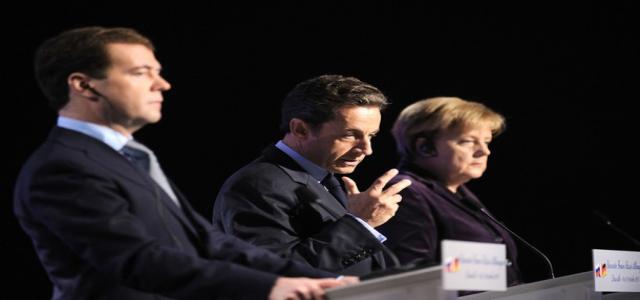
Despite the Cold War, Russia and Europe traded commodities entirely reliably and since abandonment of Russia’s command economy with its dogmas a broad movement for closer economic links has developed. More importantly, Russia’s culture is European in depth so it has also been possible for imaginative Europeans to think in terms of other areas of convergance. Deauville summitIt was therefore a welcome surprise to read of the Deauville summit this week at which Russian President Dmitry Medvedev, his French counterpart Nicolas Sarkozy and German Chancellor Angela Merkel had a meeting of minds on, in the Russian view, building “a common vision of Europe”. Apparently, Medvedev sees Russia as part of Europe, which is an excellent sign. There is a great deal to gain on both sides, in both economic and political terms. Moscow hopes to create a Russia-EU committee on foreign policy and security, according to Russian news reports, and to build security cooperation in the “Euro-Atlantic and Eurasia region”. French diplomats have floated the idea of a new zone of economic and security cooperation comprising the EU and Russia, while German officials say they are open to the idea of Russian participation in the EU’s political and security committee, which is responsible for setting the bloc’s foreign policy. (See “At Deauville, Europe embraces Russia”,New York Times.) An important suggestion is the possibility of Russia scrapping its visa requirements for European Union visitors. This would have an enormously positive effect in marketing Russia as part of Europe to the EU public, which has an older generation impressed with memories of the Cold War and younger people who, certainly in Britain, have recently been subjected to a barrage of pro-American propaganda about Russian aggression following the Georgian invasion of South Ossetia. Russia is a treasure trove of interest to tourists and of possibilities for business. Making the country more accessible and a good personal experience to visitors will pay enormous dividends on both sides. France and Germany in the leadUS divisivenessAmerica, which controls NATO, has pushed for the EU and NATO to extend to Russia’s borders in its own interests, as it mistakenly perceives them. Worse, at the same time as pressing for EU and NATO admission for Georgia, the US initiated a war between Georgia and Russia. The UK’s Brown government and the UK media were unanimous, with the US, in loud condemnation of Russian aggression. Those event were thoroughly investigated by the EU. The US role and the UK’s partisanship will have been seen very negatively by the core EU countries and Russia. Why only France and Germany with Russia at Deauville? Some countries are upset at this. Obviously these are the biggest EU countries with the strongest economies and armed forces. A factor just as important however is the history of these countries. France and Germany were the initiators of the European Coal and Steel Community (ECSC) with the objective to make war between them impossible by economic integration. That small beginning became the European Union. Russia suffered terribly in World War II and has had the unhappy experience of invasion from both France and Germany. These three countries have a visceral aversion to warfare that Britain and the United States, because of their own histories of successful aggression, do not feel. Britain and the US do not, therefore, understand the core motivations of Europe and Russia. Iran, Turkey and Shanghai Cooperation Organization The SCO group includes China, Russia, Kazakhstan, Kyrgyzstan, Tajikistan and Uzbekistan. At the 2010 meeting in Yekaterinburg, India, Pakistan, Iran and Mongolia attended as observers. The request from the US to attend as an observer was refused; it is not, after all, part of Eurasia. Essentially, the European Union has an opportunity to join this continent-spanning group from the advantageous economic position of having Russia, the European member, on its borders with Russia taking primary responsibility for security problems that might arise when dealing with the others. Fundamentally, because of its geographical position, Russia is seeking not dominance as the American narrative would have it, but security and stability. The EU offers the best initial possibilities here. It is an opportunity that the EU should seize. We are seeing not only a deepening relationship between the EU and Russia but the commencement of Eurasian cooperation across the whole continent. The push factor is that the United States has become a source of global problems. Unhappily, because of its own publicly-stated objectives of full-spectrum military and financial world dominance, the US sees enemies and countries to “contain” or for interventions everywhere. Its mistaken actions are contributing to serious instabilities. The pull factor is the need for law and stability at a time when patterns of trade and resource availability are changing. Britain out in the coldIt is unfortunate that Britain has attached itself strongly to the US both economically and militarily. Britain’s enthusiasm for the European Union project is so weak that it would not have occurred to the Deauville three to invite its participation in these talks about wider integration. Britain’s neglect of Europe and Russia is to its economic and strategic disadvantage. There is little doubt that it is now merely a satrapy of the United States. Its allegedly independent strategic nuclear deterrent, the Trident submarine system, now has the systems for arming, fusing and firing its warheads designed and manufactured by the United States. There have been problems in obtaining proper information about these, clearly because the US controls the use of these weapons. Effectively, therefore, Britain has no independent strategic defence at all; Trident is merely an arm of the US military and might as well be scrapped. Afghan quaqmireI would urge the Cameron-Clegg government to take the one decisive action that will assert Britain’s independence, impress Europe and the Russians and commit the country to an independent, realistic place in the world: leave Afghanistan militarily immediately and instead support purely humanitarian work there. It is now well known that the British army was run out of Basra. If that was because it would not take murderous action such as the the US inflicted on Falluja, there is no shame in it, but however it is viewed, British participation in the Iraq war has done it no credit. The same is true in Afghanistan. For all the deaths on both sides no good has come, nor can come of it. There will be no ethical credit accrued nor lessons learned from staying in Afghanistan another four years or until the Americans give permission for British troops to leave. The opportunity is to leave now and put down a marker for Britain’s own character and self-reliant development. Source: Redress Information & Analysis (http://www.redress.cc). Material published on Redress may be republished with full attribution to Redress Information & Analysis (http://www.redress.cc)
|
|||||||||
|
tags: France / Russia / Germany / US Foreign Policy / European Union / Iraq / Afghanistan / Iran / Nuclear Program / Britain / China / Cold War / US Military / American Invasion / Iranian Nuclear Program
Posted in Other Issues |
|||||||||
|
|||||||||
|
|
|||||||||
| Related Articles | |||||||||
|
|
 Back to Homepage


 Facebook
  Digg
Digg  Yahoo
Yahoo  Del.icio.us
  reddit
  StumbleUpon
  Mixx
Mixx  Google


Twitter
Facebook
Most Viewed
Join Our Maillist
Video


|
© The Muslim Brotherhood All copyright and re-transport from the site of any material are allowed as long as the source mentioned |
