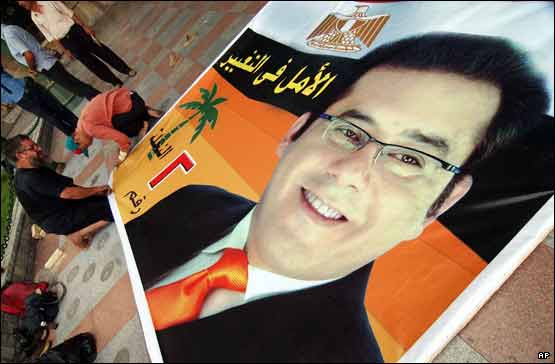
Outside the penthouse apartment which Ayman Nour, Egypt’s recently released opposition leader, can once again call home, dozens of bouquets of flowers crowd the doorway.
It has been a week since his release from prison, but Mr Nour, 44, shows few signs of his 38-month incarceration. As he bounds out of the doorway to attend yet another interview with an Arab TV station, he is stopped by supporters who hug and kiss him.
“Thank God for your release,” said Mohammed Bahey, one such passer-by. “We’ve always known you were innocent. You enlighten your house, neighbourhood and Egypt.”
Inside Mr Nour’s apartment, there are more celebratory flowers, some of which are orange, the colour of his Al Ghad, or Tomorrow, party.
He apologises for being late for an interview with The National, saying he has had little sleep since his release on Feb 18 and even his wife’s mother has told him to slow down.
“My mother-in-law was just telling me, ‘Enough’ … she is worried I will provoke politicians,” he said, dressed smartly in a dark blue suit and light blue tie and sitting under a large painting of him, Fathi Serour, the speaker of parliament, and other prominent legislators.
But it seems that provoking politicians is what Mr Nour does.
He was the youngest member of parliament from 1995 until 2005, when he ran against Hosni Mubarak in the country’s first presidential elections, coming a distant second. His fall from power continued with the loss of his seat in parliament in legislative elections later that year. Then on Dec 24 he was sentenced to five years in prison for fraud.
“I still don’t know why they suddenly released me, and what they want from me, and I don’t care,” Mr Nour said as he took a sip of Turkish coffee and lit a cigarette. “But I know what I want to do after getting out: to rebuild my party and my liberal trend.”
“Al Ghad has a real chance to do something different because it represents a different state, generation, logic and way of thinking, and I’m very serious and enthusiastic about it,” he said.
Al Ghad received a licence to form a political party in late 2004. Eighty-nine days later, in Jan 2005, Mr Nour was detained on charges of forging powers of attorney in order to bring about the formation of his party – charges he has always denied.
He was released two months later pending trial. He ran in both the presidential and legislative elections while on trial but was convicted in December that year.
His imprisonment caused an international outcry and has been a sticking point in Egyptian-American relations. While local and international human rights groups have appealed for his release, Egypt’s state-owned media have been less than supportive, portraying his release as having no bearing on his innocence and motivated by ill health.
But many have speculated that Mr Nour’s release was influenced by Egypt’s desire to open a fresh dialogue with the new US administration. Mr Nour wrote a letter from prison to Barack Obama last year, after Mr Obama announced he would contest the election. The letter was published in several Egyptian dailies.
Some claim Mr Nour was released after agreeing not to challenge the government, while others claim his release was motivated by a desire on the part of the authorities to provide a wider political alternative to the Muslim Brotherhood. Mr Nour denies any deal with authorities.
But there are also questions about what Mr Nour can hope to achieve. Under Egyptian law, which designates fraud as a dishonourable crime, he is banned from taking any political role or running in any elections for five years.
“I will appeal against this law, it’s unconstitutional and outdated,” said Mr Nour, who is a practising lawyer and has a law firm, which is also the headquarters of Al Ghad party.
Samir el Shehtawi, a lawyer with Mr Mubarak’s ruling National Democratic Party, has filed a lawsuit against Mr Nour aimed at expelling him from the Lawyers’ Syndicate.
“Obviously my imprisonment and all that I’ve gone through is not enough for the regime,” said Mr Nour. “Now they are hiring people to fight me over my source of income and life. I came out calling for dialogue with all, including the NDP, but they are insisting on fighting me. They are waging war, and I have no choice but to fight back, by law. It seems this is my destiny, and most of the time it gives me energy,” he said, lighting another cigarette.
“But I’m physically tired, psychologically OK, not ecstatic, you know. I’m balanced, but suspicious a bit and worried, I know it will be a fierce battle, and I didn’t get ‘warrior’s rest’ or a break, I’m still trying to adapt to life outside prison,” he said.
Mr Nour suffers from diabetes and heart problems which have led to hospitalisation on several occasions, and he repeatedly appealed for release from prison on medical grounds.
Mena, Egypt’s official news agency, reported the day Mr Nour was released that the general prosecutor had issued a decree for the release of nine defendants for health reasons.
“I see the regime is in a dilemma reflected in confused behaviour at all levels,” said Mr Nour. “I don’t know how they will handle the Al Hussein terrorist attack among all the other pressures on them,” he said, referring to the bomb blast on Sunday night in front of the Al Hussein mosque that killed a French teenager and injured several other tourists and Egyptians.
“I feel nothing has changed in Egypt’s paralysed political life since I went to prison and even 10 years ago,” Mr Nour said. “The main crisis is emanating from their insistence that the same ruling party, who has been in power for more than 30 years, continue to rule alone for ever, despite its failure, and at any cost,” he said.
“No one can argue that Egypt needs change, new blood and spirit. The regime is ageing and drifting more and more away from the average Egyptian.”
Mr Mubarak, 80, has been in power since 1981. His youngest son, Gamal, 45, has been gaining in influence on the political scene since 2002 and is viewed as his father’s heir apparent, although both men deny that. Gamal has risen swiftly in the ranks of the party in the past few years, and often tours Egypt with ministers. He has met George W Bush, the former US president, and other European officials.
“I’m not against Mr Gamal Mubarak’s practising his constitutional right of engaging in politics, but I’m against him using the fact that he’s the president’s son as his main qualification,” Mr Nour said. “We were, and still are, against inheritance of power. I and my party paid a heavy price for that, but we will continue to oppose it, no matter what the price might be.
“Egypt doesn’t need inheritance of power. It needs real, young and promising parties, and I see Al Ghad as representing all that.”
Mr Nour will not be the official head of the party, as Ihab el Khouli was elected and recently reinforced in that role by the court after bloody clashes with a splinter group which set the party’s headquarters in downtown Cairo on fire in November.
“I will be the [ideological] leader of the party and will roam Egypt and visit all of its provinces and all of those who want to meet me to build the party and increase its membership,” Mr Nour said.
If he manages to overcome the legal obstacle of returning to politics, will he run in legislative elections next year and the presidential elections in 2011?
“Are you asking me about my decision or my ambition?” Mr Nour said with a smile.
“If Al Ghad nominate me, I will run. My ambition is to run, of course.”
He said he has the support of his wife Gamila Ismail, and their two sons, Nour, 18, and Shadi, 17, despite what they have been through over the past four years.
“Sometimes I feel guilty about the price my family had to pay and what they had to endure because of my political ambitions,” he said.
“I haven’t been around enough for them, I didn’t watch my sons growing, and I was away during their adolescent years.”
Besides becoming more religious in prison and reading and writing more than he ever had (he wrote a regular column for the opposition daily Al Destour), he said was more forgiving now and more able to understand the suffering of others.
“I feel and sympathise more with the oppressed now. It’s very different to talk about oppression as a concept and then to live it.
“However, the deep feeling of injustice created a bitterness inside me, made me lose faith in justice in Egypt, and I’m not sure what will happen next. I don’t know if I’ll ever be able to overcome this feeling.”
nmagd@thenational.ae